Quick Answer: Ground mounted solar power uses fixed or tracking structures installed on open land instead of rooftops, suited to industrial plants, institutions, and farms with available land. Costs depend on land prep, structure type, and system size; space needs exceed rooftop systems due to row spacing for shading avoidance.
When Ground Mounted Solar Makes Sense
Ground mounted solar is a good fit when you have suitable open land but limited or unsuitable rooftop space. It can also make sense when the project needs a larger solar installation than the available roof can support.
Unlike rooftop solar, ground-mounted systems are built on dedicated land. This gives the project more flexibility in panel layout, orientation, access, and system size. It also means the project may need additional work for foundations, grading, drainage, fencing, and cabling.
For industrial plants, institutions, and farms, the decision usually comes down to three questions: Do you have enough suitable land? Is the land easy to develop? And would a ground-mounted system make more sense than using the available roof?
How Ground Mount Installation Works
Solar ground mounting follows a defined sequence: site survey, foundation work, structure erection, panel installation, and cabling.
- Site survey: Soil testing, land assessment, shading analysis, and layout planning help determine the foundation and system design.
- Foundation: Concrete or driven-pile foundations may be used depending on soil and structural requirements.
- Structure erection: Steel or aluminum mounting structures are assembled on the foundations.
- Panel installation: Solar modules are fixed to the mounting structures at the designed tilt and orientation.
- Cabling and connection: DC cables connect the modules to inverters, followed by AC connection to the site's electrical system or grid.
After commissioning, SCADA monitoring tracks plant output and flags underperformance, while O&M contracts cover ongoing cleaning, inspection, and repair so the system keeps running at expected output.
Fixed-Tilt vs Tracking Structures
Ground-mounted solar structures generally use either fixed-tilt or tracking systems.
Fixed-tilt structures hold the panels at a set angle throughout the year. They have fewer moving parts and are commonly used where a simpler structure and lower mechanical complexity are preferred.
Tracking structures move the panels during the day to follow the sun. They can increase energy generation, but they also add mechanical components, controls, and maintenance requirements. Whether the additional output justifies that added complexity depends on the project design and economics.
Structure durability also depends on the material, protective coating, foundation design, wind conditions, soil properties, and site environment. These factors should be assessed during engineering rather than treated as one standard requirement for every site.
How Much Land Does Ground Mounted Solar Need?
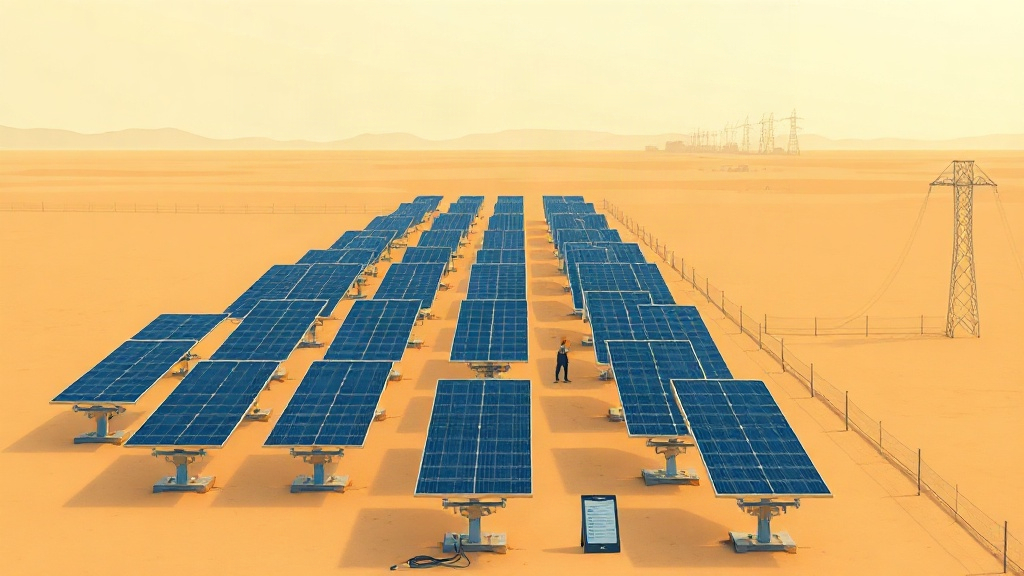
Ground mounted PV panels need significantly more land per kW than rooftop systems because rows must be spaced apart to avoid self-shading as the sun angle changes through the day. A ground mount for solar panels layout typically runs panels in parallel rows with access paths between them for maintenance and cabling.
Worth Knowing: Row spacing is calculated from the site's latitude and the lowest sun angle in winter, since shading losses are worst when the sun sits lowest in the sky.
Flat, well-draining land with minimal shading from trees or structures is preferred, and sites with irregular terrain may need additional grading before structure installation can begin.
What Affects the Cost of a Ground Mounted Solar System?
The cost of a ground-mounted solar project depends on more than the panels. Major cost components can include:
-
Solar modules and inverters
-
Mounting structures
-
Foundations and civil work
-
Land grading, drainage, and fencing
-
DC and AC cabling
-
Transformers and other electrical equipment
-
Grid connection and evacuation infrastructure
-
Installation, commissioning, and O&M
Site preparation can become a larger cost factor when land requires extensive grading, drainage, or foundation work. Structure choice also affects the project cost, with tracking systems generally requiring more mechanical equipment than fixed-tilt structures.
System size then affects the overall quantity of equipment, civil work, cabling, and labor required.
For a detailed cost breakdown by capacity, see the 1 MW solar plant cost and ROI guide.
Why changed: The original three cost drivers were useful, so they remain. I expanded the section to show what those costs actually consist of. This makes the section more useful without adding unsupported pricing.
Budget Insight: Solar ground mounted projects on flat, pre-cleared agricultural or industrial land generally need less civil work than projects on uneven or rocky terrain, which directly affects total project cost.
For a detailed cost breakdown by capacity, see the 1 MW solar plant cost and ROI guide.
Ground Mount vs Rooftop: Which Fits Your Site
A solar ground mount system and a rooftop system solve different site constraints, and the right choice depends on available land, roof condition, and budget.
| Factor | Ground Mount | Rooftop |
|---|---|---|
| Land availability | Requires dedicated open land | Uses existing roof space |
| Civil cost | Higher (foundations, grading) | Lower (uses existing structure) |
| Maintenance access | Easy ground-level access | Requires roof access |
| Orientation control | Optimal tilt and spacing possible | Limited by roof shape/angle |
| Best fit | Farms, large industrial sites with land | Factories, warehouses with strong roofs |
Ground mount solar panels suit farm owners under KUSUM and industrial sites with spare land. Rooftop suits facility managers who want to avoid land costs and use existing building area; see industrial rooftop solar solutions for that option. For a deeper side-by-side, read ground mounted vs rooftop solar: which is better.
Which Government Scheme Applies to Ground Mounted Solar?
PM-KUSUM is the government scheme directly relevant to certain farmer-led ground-mounted solar projects. Under Component A, eligible farmers, groups of farmers, cooperatives, panchayats, Farmer Producer Organisations, and Water User Associations can develop decentralized ground-mounted or stilt-mounted grid-connected renewable energy plants, subject to the scheme and state implementation requirements.
For a ground-mounted project, eligibility, project capacity, land requirements, grid connectivity, tariff arrangements, and the application process depend on the applicable scheme and state-level implementation. Check the current scheme requirements before budgeting or committing to a project.
How Raycal Power Helps With Ground Mounted Solar
Once you know that ground-mounted solar could fit your site, the next step is a site assessment rather than choosing equipment from a generic price list.
Raycal Power is a solar EPC company that handles ground-mounted projects from site assessment and system design through civil and structural work, electrical installation, grid interconnection, commissioning, and O&M. Its ground-mounted service covers site assessment, solar design, civil and structural work, electrical works, grid coordination, and ongoing monitoring.
That process matters because land availability alone does not determine whether a project is viable. Soil conditions, site layout, shading, electrical infrastructure, grid connectivity, and the intended system size all affect the final design.
For a project-specific assessment, you can request a free site assessment from Raycal Power.
Frequently Asked Questions
What Is the Cost of 1 MW in PM Kusum Yojana?
Cost per MW under PM KUSUM depends on the subsidy slab, state, and component selected, so this figure must be confirmed with the scheme administrator or a Raycal Power representative before budgeting.
How Much Does a Ground Mounted Solar System Cost?
Cost depends on system size, land preparation needs, mounting structure type, and local subsidy eligibility. Get an exact quote through a site assessment rather than relying on generic figures.
What Are the Disadvantages of Ground-mounted Solar Panels?
Ground mounted systems need more land than rooftop systems and may require site prep such as leveling, fencing, and cabling runs, which raises upfront civil cost. These tradeoffs are often offset by easier maintenance access and better panel orientation.
What Is the Cheapest Ground Mount Solar Panel?
Panel pricing varies by brand, wattage, and efficiency tier, and specific model pricing should be confirmed directly with your EPC provider at the time of quoting.